


Declaration of Arbroath
"...as long as but a hundred of us remain alive, never will we on any conditions be brought under English rule. It is in truth not for glory, nor riches, nor honours that we are fighting, but for freedom -- for that alone, which no honest man gives up but with life itself."
Declaration of Arbroath
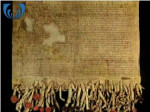
Video presented by Professor G.W.S. Barrow with a narration of part of the Declaration.
Like the American Declaration of Independence - which is partly based on it - the Declaration of Arbroath on 6 April 1320, by 38 Scottish Lords, is seen as a founding document of nationhood.
Background
John Balliol had been adopted by the English king, Edward I, as his favoured candidate for the Scottish throne. He was chosen above twelve other claimants which included Robert Bruce. Balliol was inaugurated at Scone in 1292. His short reign was dominated by Edward's attempts to control the governance of Scotland, as he claimed, in the role of feudal suzerain.
Balliol Surrenders Crown

Edward stripped King John Balliol of his English estates and the kingship in 1296. This action earned Balliol the nickname 'Toom Tabard' (empty tunic) which referred to his loss of knightly trappings. Initially, Edward kept him prisoner but eventually he was exiled to his feudal lands in France where he died, later than Edward, in 1313.
The throne went to his rivals, the Bruces, but his support in Scotland remained strong and he was allied through marriage to the very powerful family of Comyn, who were Lords of Badenoch and Earls of Buchan. The Red Comyn was his nephew.
Although the English armies under Edward II had been defeated at Bannockburn in 1314, they continued to mount attacks into Robert the Bruce's Scotland over the succeeding years. They claimed Scotland was not independent and, in fact, a previous claimant to the Scottish throne had made a deal with Edward.
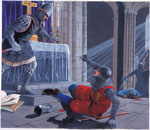
Pope John XXII of Avignon, France, had not accepted Scottish independence, perhaps because Robert the Bruce had been excommunicated for killing John Comyn in a church in Dumfries in 1306. It was the Red Comyn who had formed an alliance with Edward, and perhaps had more of a right to be King than Bruce.
Murder of Red Comyn
The Pope is Petitioned
Thus the Declaration of Arbroath was prepared. It was drawn up in Arbroath Abbey on the 6th April 1320, on behalf of the nobles and barons of Scotland. Its most likely author was the Abbot, Bernard de Linton, who was also the Chancellor of Scotland.
It was one of three letters sent to the Pope. The others were from King Robert Bruce and from four Scottish bishops. Sir Adam Gordon took the Declaration to the papal court in France.
The Declaration urged the Pope to see things from a Scottish perspective and not to take the English claim on Scotland seriously. It used strong words, indicating that without acceptance of the Scottish case that the wars would continue and the resultant deaths would be the responsibility of the Pope.
Signing Tableau

Do we Know the True Purpose of the Declaration?
There is some debate over the purpose of the Declaration. Some see it as an explanation about fighting in the British Isles when the Pope expected Christian Princes to be on Crusade in the Holy Lands.
There is other evidence to suggest that it was an attempt to have King Robert the Bruce received back into the Church, as he wished to go on crusade and excommunicants were excluded.
Others see it as the first formal statement of nationhood and rights which also puts expectations on the King by those he rules. It certainly follows Magna Carta of 1215.
"Yet if he (Bruce) should give up what he has begun, and agree to make us or our kingdom subject to the King of England or the English, we should exert ourselves at once to drive him out as our enemy and a subverter of his own rights and ours, and make some other man who was well able to defend us our King..."
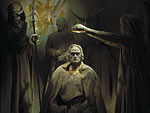
Crowning Bruce
The People and Their King
And the extract above does seem to state the people choose their King to represent what they - the people - believe in. That, in itself, was an almost unknown public view at this period. Monarchies were based on the Divine Right of Kings: they were chosen by God. That being said, Bruce almost certainly believed in Divine Right. After all, he had himself crowned. He didn't take a vote.
However, it also cleverly gives an explanation of Bruce's killing of John Comyn. After all, that murder could be viewed through the above argument as the people choosing their King because Comyn was seen as acting against the wishes of the people in forming an alliance with Edward.
With all that being said, the Declaration of Arbroath remains surprising, adept and important. It was a step towards the sort of constitutional monarchy we see now.
Related Information
The Declaration of Arbroath was written in Latin. Here is an English translation.


 Facebook